Why Organisational Age Doesn’t Equal Maturity
The hidden cost of neglect and how it quietly destroys performance and profit.

Organisational age is often mistaken for maturity, but time alone does not create capable systems.
As organisations grow, foundational disciplines are frequently deprioritised in favour of visible delivery and short-term profit.
This hidden neglect quietly erodes people, trust, and performance sustainability. True maturity is built deliberately through aligned leadership decisions, adaptive systems, and disciplined effort over time.
The Growth-Is-Great Assumption
Jim Collins’ book From Good to Great is frequently referenced by leaders aspiring to scale their organisations. Growth is often viewed as proof of success — bigger teams, bigger revenue, bigger impact.
In small organisations, growth and organisational age are commonly seen as signals of improving performance and profitability at scale. In long‑standing medium‑to‑large organisations, age is often assumed to equal maturity: more discipline, better systems, and stronger governance.
That assumption is rarely tested.
Reality Shift: Big Isn’t Always Better
The longer an organisation operates, the harder it becomes to change the people, processes, and systems that drive decisions and delivery.
On the path to growth, many organisations quietly deprioritise the “engine room” work — governance, learning, process renewal, and system health because it doesn’t immediately show up in productivity reports or profit discussions. These foundations are labelled important but not urgent. Delivery continues, so the risk remains invisible.
Without discipline and continued investment in foundations, even long‑standing or once‑successful organisations can fail spectacularly. This is why How the Mighty Fall is, arguably, Jim Collins’ more important book.
Age Doesn’t Equal Effectiveness
Longevity does not guarantee optimised performance. It does not mean people are supported, money is well spent, or effort is well directed.
One of the most extreme examples I’ve seen was a 25‑year‑old private organisation with over 4,000 employees and a 50% staff turnover rate within the first 12 months of every hire. Turnover was culturally normalised and justified as part of a “market disruptor” identity.
The organisation was profitable.
It was also wasting enormous value burning people, degrading service quality, and leaving higher‑value opportunities unrealised.
The organisation was old. It was organisationally immature.
The Maturity Factor
The greatest difference between organisations that sustainably optimise performance and profit, and those that don’t, is organisational maturity.
Organisational maturity refers to how well‑developed, capable, and aligned an organisation’s people, processes, and technologies are to deliver value consistently.
In Adaptive Excellence, maturity is not about perfection. It is about an organisation’s ability to operate deliberately, adapt safely, and improve without burning people or creating hidden risk.
While maturity models vary by industry, they generally progress through recognisable patterns:
Level 0 – Nil: Fragmented, unclear, and reactive responses to customer needs and risks.
Level 1 – Initial: Roles and processes are unclear, effort is duplicated, and work is largely reactive.
Level 2 – Basic: Objectives are mostly met, but delivery is clunky and reporting lacks insight.
Level 3 – Defined: Quality and consistency improve end‑to‑end, reporting reveals meaningful opportunities.
Level 4 – Managed: Teams are calm, capable, and trusted to adapt and implement change safely.
Level 5 – Optimised: Teams operate in adaptive excellence, continuously improving value delivery.
Maturity is not linear, it can vary between teams, and people will only be as effective as the broader system itself.
Under pressure, organisations frequently regress unless foundations are actively maintained.
The level of maturity directly shapes culture and determines whether change efforts succeed or fail.
Immature vs Mature Organisations
Immature organisations tend to exhibit:
Unclear functions and duplicated effort across silos
Downplayed or hidden risks
Constant urgency driven by risks and issues that should have been addressed earlier
People feeling overwhelmed, reactive, and ineffective.
Mature organisations demonstrate:
Alignment between strategy, systems, and execution
Clear mechanisms for improving delivery, knowledge flow, and digital capability
Psychological safety to raise risks early
Incremental, team‑led innovation and adaptation
People feeling calm, capable, and considered.
The Core Leadership Tension
There is always tension between:
Protecting current high‑value operations, and
Building future capability, impact, and profitability
This is the central leadership challenge addressed in the Leadership–Decisions–Delivery lens.
When the current state is fragile, leaders and teams lack the emotional, cognitive, and physical capacity to change.
When future ambition is pursued without strong foundations, success becomes unsustainable. People burn out, risks escalate, and failure accelerates.
Leaders do not lift performance by demanding more.
They create it by designing better systems of work.
Why Maturity Models Matter
Maturity models support clarity, confidence, and progression by:
Defining what “good” looks like at each stage
Reducing confusion and rework
Supporting continuous improvement without overwhelm
Helping teams see how their work connects to organisational value.
They replace hope with visibility, and effort with intent.
The ADAPT & EXCEL Method®
Mature organisations sustain performance by regularly reviewing and strengthening their foundations while evolving how value is delivered.
The ADAPT & EXCEL Method® is an evidence‑based approach to realistically develop organisational maturity by aligning strategy, people, processes, technology, and culture.
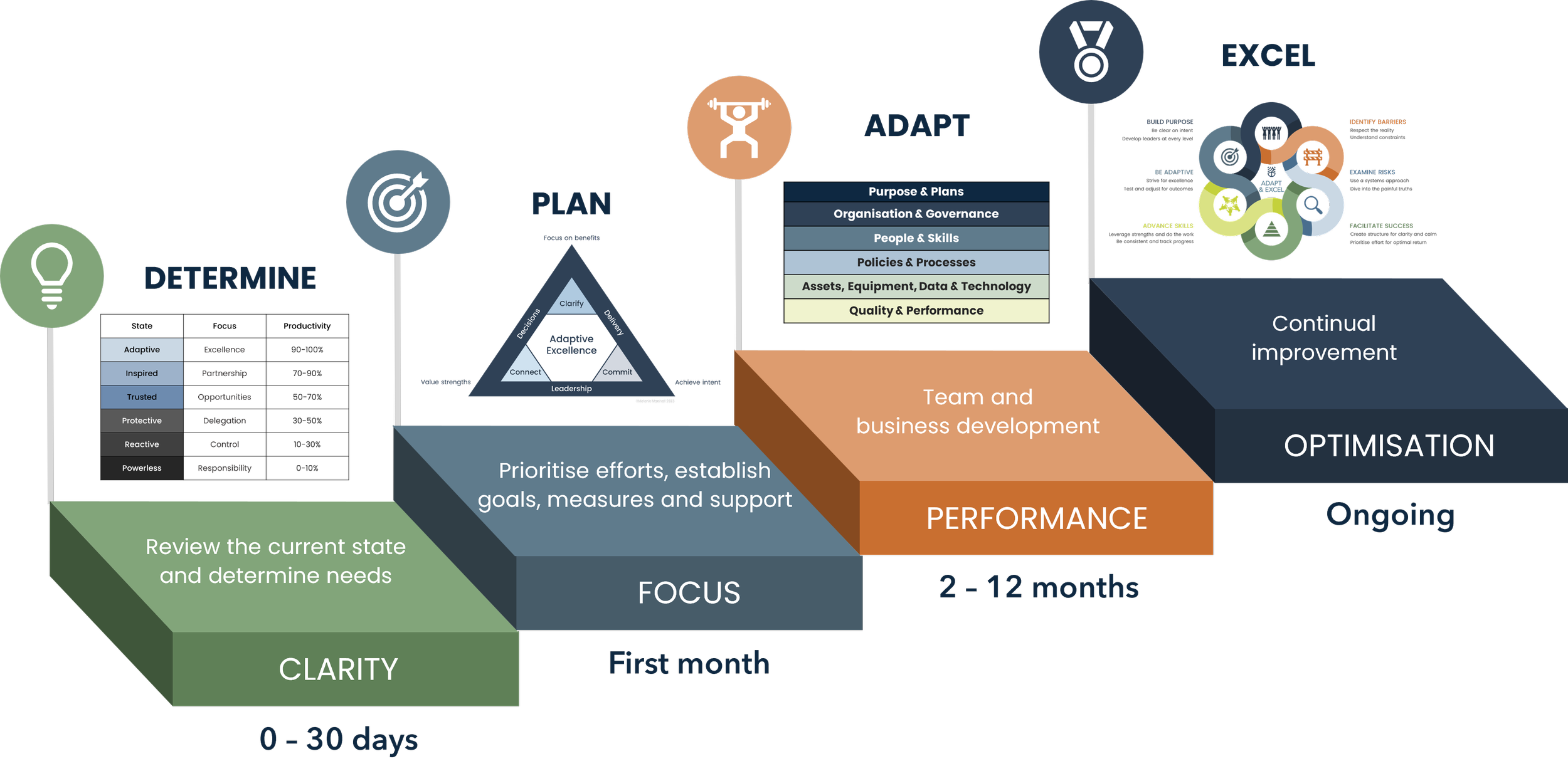
Figure 1 - The ADAPT & EXCEL Method®
Successful organisational change and evolution involve:
Understanding current maturity and friction points
Reviewing leadership, decision, and delivery effectiveness
Building integrated foundations for operational strength and resilience
Embedding a culture of adaptive excellence over time.
Sustainable high performance is never accidental. It is the outcome of deliberate choices to consistently build trust, clarity, and capability.
Three Adaptive Moves
Re-anchor to purpose
Ensure operational plans clearly align to long‑term strategy. Be explicit about why each function and activity exists.Strengthen business foundations for effective delivery
Understand maturity levels and systematically remove friction in how work gets done.Enable people and performance
Develop the ecosystem with discipline so people can deliver with relative ease and flow over time.
Organisational maturity does not come with age. Age simply amplifies what already exists.
The responsibility for performance, trust, and sustainability sits squarely with leaders and the systems they choose to design, maintain, or neglect.
For your outcomes,

Bibliography:
(1) Melanie Marshall (2025) Adaptive Excellence – How the best leaders and teams optimise performance and profit.
(2) Kucińska-Landwójtowicz, A., Czabak-Górska, I. D., Domingues, P., Sampaio, P., & de Carvalho, C. F. (2023). Organizational maturity models: The leading research fields and opportunities for further studies. International Journal of Quality & Reliability Management. https://doi.org/10.1108/IJQRM-12-2022-0360
(3) https://cmmiinstitute.com/learning/appraisals/levels