Everyone wants to perform well. For better or worse, we use feedback from others to validate our sense of purpose and value. When feedback isn't great it can feel like we're struggling at school.
Leading people requires many skills; especially keen observation, lots of listening, and the ability to give and receive feedback. Great leaders are engaging and enable team excellence.
High-performing leaders and teams seek regular feedback to drive change and optimise performance and profit.
Employee engagement is an important measure of work culture and company value. People who are engaged are motivated by what they do, are more productive, speak positively about the team, and are more likely to stay with the company.
“When everyone’s on the same page and working together smoothly, things get done faster and with less hassle. It just makes the whole experience more enjoyable and productive!” Adaptive Review Participant
Companies with high employee engagement experience greater customer satisfaction and 23% higher profits than those with lower engagement.
Without employee feedback, the risk of setting unrealistic expectations, limiting the organisation’s potential, and failing to deliver strategic outcomes increases.
Feedback from conversations, observations of how people work, and more formal surveys are essential for engagement and innovation.
When used effectively, these mechanisms provide access to the everyday experience and voice of people delivering the organisation’s products and services. Asking for and getting feedback can be problematic though.
Getting feedback is hard
Your position in the company determines what you see and how much information people are willing to share. Knowing how to ask the right questions and managing responses can also be tricky.
Regardless of how approachable and open we are to obtaining feedback; feedback makes us feel vulnerable.
This vulnerability is amplified in leadership positions because we’re exposed to greater feedback volume, scrutiny, and accountability for our performance, the team’s performance, and the business in general.
Giving and receiving feedback can be clouded by a fear of retribution for negative feedback either given or received, conflicting feedback on what is and isn’t working, the temptation or pressure to bury bad news, inadequate skills, resources, and time to respond effectively.
Common mistakes
Feedback is an art form. It can be hard to give and get feedback that isn’t soul-destroying or a waste of time.
Common feedback mistakes are:
Asking the wrong questions or questions we don’t want answers to.
Hiding from what people have said because it’s painful.
Using negative feedback for punishment.
Not using feedback to adjust for better outcomes.
Not measuring and celebrating action driven by feedback.
To get the most value from feedback, it’s important to have a clear purpose, set some boundaries for obtaining and giving feedback, seek the feelings, facts, and stories of people's experiences, and share how the feedback is being used to facilitate change and celebrate progress.
3 ways to optimise feedback
Feedback between leaders and teams is a strategic and operational gift because innovation is largely driven by insights into people's experience of delivering.
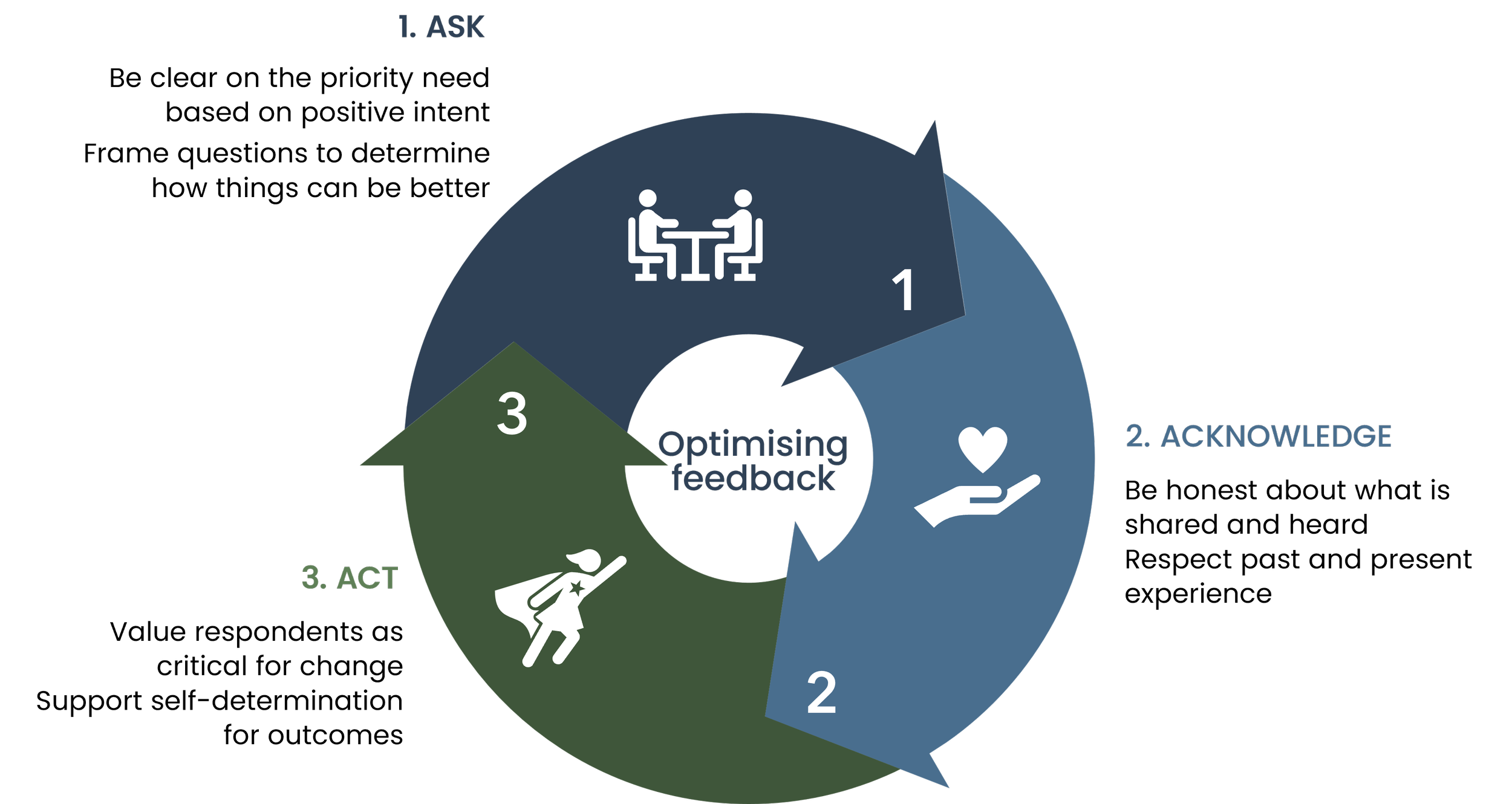
Ask – Be clear about the specific purpose for each question or the feedback being given
Acknowledge– Be honest about what is shared. Use feedback to design and drive change with the experience of respondents
Act – Facilitate and support respondent-determined action by starting with one topic, doing two things to improve it, and checking progress three times
Creating a culture of excellence is everyone’s responsibility. Giving and receiving feedback constructively is imperative for action toward aspirational goals and lasting success.
Want better feedback? Call me on +61 407 004 352 or book a conversation.
For your outcomes,
Melanie.
Sources:
Gallup (2024). State of the Global Workplace 2024 Report: The voice of the world’s employees.
Burris, E., Thomas, B., Sodhi, K., & Klinghoffer, D. (2024). Turn Employee Feedback into Action – What to listen for and how to respond. Harvard Business Review, November-December 2024.
Priem.J. (2023). Employee Engagement: Close the Action Gap to Drive Business Outcomes. Gartner White Paper
Tucker, S., & Turner, N. (2015). Sometimes it hurts when supervisors don’t listen: The antecedents and consequences of safety voice among young workers. Journal of occupational health psychology, 20(1), 72.
Shepherd, D. A., Patzelt, H., & Berry, C. M. (2019). Why didn’t you tell me? Voicing concerns over objective information about a project’s flaws. Journal of Management, 45(3), 1087-1113.