We’ve all been stuck in being “too busy” where optimising performance wasn’t a priority because we needed things to “settle down” first. This might be ok from time to time but if “busy” is the standard response to how you and the team are you’re in real trouble.
On the other hand, you and the team might have so many improvement initiatives underway that people feel overwhelmed and burned out.
The dilemma
From an employee perspective, the thought of executive teams driving continual improvement or a high-performance agenda to optimise delivery often leads to eye-rolling.
People think they’ll be expected to do more work or work harder when current people and resources aren’t enough. The thought of adding extra things, even if temporary, to the growing list of what can’t be done hurts:
· Messages around cutting costs and doing more with less don’t motivate anyone.
· Under the strain of day-to-day operations, key people and teams “don’t have the time” to be involved with consultation and preparation work for any changes.
· Delivery teams likely want to crawl under a rock and hide until everything dies down and things return to normal. Even if the current state could be better, better the devil you know is more comforting.
The truth
The harsh truth is that everyone’s been burned by poorly framed or badly executed great ideas, and probably within your business. No business is perfect.
Optimising performance isn’t about being busy or adding more pressure onto already tapped-out teams, it’s about creating calm and confidence for greatness.
Another truth is that success breeds success, people want to be members of high-performing teams, and clients and customers value what these teams provide. The greater the value of the employee and customer experience, the greater the profit.
The solution
High-performing teams optimise how they do things, by reducing friction, eliminating waste, and focusing on quality to deliver great services for maximum return.
But what does a high-performing team do differently that sets them apart from an average one?
The key difference is that they are an Adaptive Team with exceptional skills in four key areas:
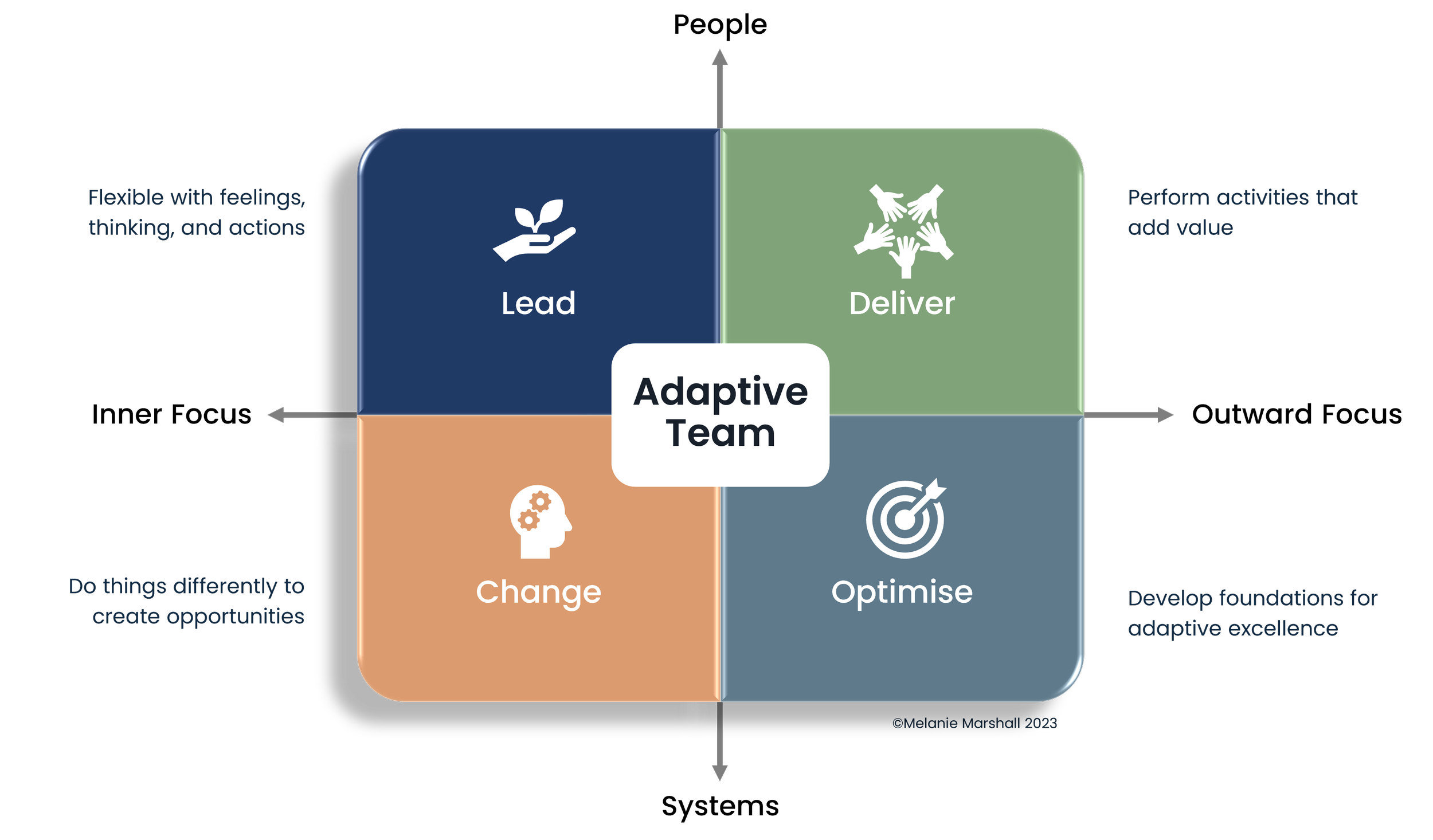
They understand and know how to lead themselves and others.
They know what’s required and how to deliver great products and services for their clients and customers.
They accept that change is inevitable. They know how to stop what isn’t working and collaboratively design and implement changes with the people most impacted by them.
They examine and approach problems as opportunities. For high-performing teams, ticking boxes and performing well isn’t enough. High performers are intrinsically driven to deliver with exceptionality. With an end-to-end approach for continual improvement, they work to increase capacity and capability across people, processes and technologies to optimise activities for the vision.
Adaptive teams are high-performing by nature, they enable a culture of excellence. They’re engaged and committed to being valuable through service, are passionate about driving exceptional customer results, and have the skills and support to do so. Individuals in the team are adaptive leaders who value, promote, and work with the strengths of others for the success of the team.
The team leader
Leaders of high-performing teams care about growing and developing other leaders, they ensure their team has the skills, support and confidence to lead, deliver, change and optimise what is needed to create the best possible experiences.
How are you developing the team’s skills and confidence for high value employee and customer experiences?
I work with medium to large business leaders committed to developing and growing adaptive and high-performing teams.
If that’s useful, let’s explore your needs, contact me at +61 407 004 352 or book a time.
For your outcomes,
Melanie.
Bibliography:
Jamshed, Samia & Majeed, Nauman. (2023). Mapping knowledge-sharing behavior through emotional intelligence and team culture toward optimized team performance. Team Performance Management: An International Journal. 29. 10.1108/TPM-06-2022-0052.
Kalkman, J. P. (2023). Radical and Swift Adaptive Organizing in Response to Unexpected Events: Military Relief Operations after Hurricane Dorian. Academy of Management Discoveries, amd.2020.0213. https://doi.org/10.5465/amd.2020.0213
Raisch, Sebastian & Birkinshaw, Julian & Probst, Gilbert & Tushman, Michael. (2009). Organizational Ambidexterity: Balancing Exploitation and Exploration for Sustained Performance. Organization Science. 20. 685-695. 10.1287/orsc.1090.0428.
Stephan, U., Strauss, K., Gorgievski, M. J., & Wach, D. (2024). How entrepreneurs influence their employees’ job satisfaction: The double-edged sword of proactive personality. Journal of Business Research, 174, 114492.
https://doi.org/10.1016/j.jbusres.2023.114492
Sukoco, B. M., Lestari, Y. D., Susanto, E., Nasution, R. A., & Usman, I. (2021). Middle manager capabilities and organisational performance: the mediating effect of organisational capacity for change. International Journal of Productivity and Performance Management.