How to Avoid Automation Failures
“Any change, even a change for the better, is always accompanied by drawbacks and discomforts.” — Arnold Bennett
Automation is often sold as the cure for inefficiencies and the fast track to getting stuff done, but fear and danger can creep in when we start delegating activities to someone, or something else.
With unrelenting pressure to deliver with limited capacity, the time to stop and reflect on what should or shouldn't be done, let alone be automated, is considered a luxury.
Ironically, we automate every day. With ingrained habits and frames for how we see the world we do many things on autopilot (e.g. cleaning our teeth, travelling the same way to work each day, making a cup of tea).
We still do the work for activities without conscious thought, but we’ve automated the cognitive load, or brain energy it used to take when learning the skill. This gives us the freedom and capacity to do more than one thing at a time.
The challenge with automation
Once we’ve developed expertise it’s a challenge to fully unpack the process when teaching someone or something else to perform with the same level of proficiency or better.
For example, write down all the steps needed to make a great cup of tea, give it to someone else to follow without deviation and I bet you’ve missed a few things –last time I counted, a cup of tea takes at least 12 steps.
Automation is only as good as the underlying processes that tell the technology what to do. Vendors can argue that you’re buying an off-the-shelf product and that you’ll conform to ‘best practices’, and get valuable benefits by adopting new things, but how much will the employee experience change and at what cost?
Successful automation doesn’t happen overnight; many structural and behavioural changes are needed for teams and the business to benefit. People, processes and multiple technologies must be integrated and ready to adopt new ways of working from the beginning to the end of a delivery lifecycle.
Know the journey
Customer Journey Models (CJMs) are visual representations or maps of who, what, when, and how a product or service is delivered. They provide an end-to-end view of a customer and employee's experience where each journey starts from searching for to obtaining what they need from a business.
There are generally 4-5 high-level stages in a customer journey. Underneath these stages are the people, processes, tools, and technologies required to deliver. Every stage will likely have a combination of digital (technological) and non-digital (people) touchpoints – because of this CJMs are useful for change preparation and make it clear that automation is never about just pushing a button.
Change and transformation initiatives fail when CJMs aren’t accurately modelled or aren’t used by developers, and project teams to design solutions, or facilitate and support people and business readiness for change.
The most preventative causes of failure are being overwhelmed and not understanding the complexities and impacts of change. People dive too quickly into the details, or executive teams in their haste to get things moving, kick off so many projects at once that people can’t see the forest for the trees.
Five steps to ensure quality and create ease:
In business, no one wants average products, services or profits and we all make mistakes.
Here are five steps to ensure quality and create ease when preparing for change:
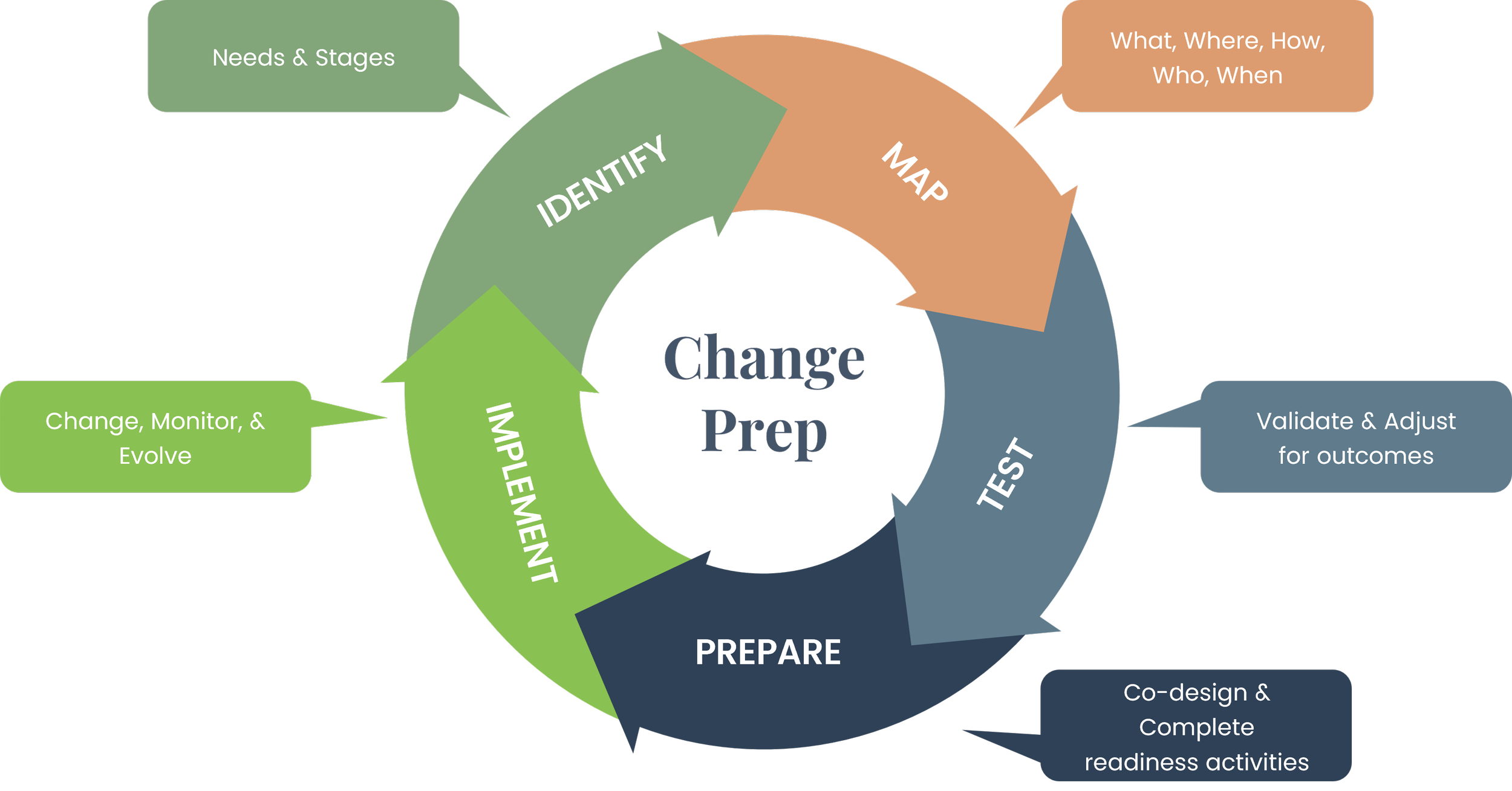
Identify the high-level needs and define the key stages of a customer journey
Map the steps or actions in each stage from beginning to end. Ask the newest member of the team, or someone from another team, to draft or update procedures within each stage by observing a longer-term team member performing the work. Ensure they don’t move to the next stage and process until the first one is complete.
Test the entire journey for quality and effectiveness with the broader team, and people outside the team who are impacted to refine and optimise how things will be done for the desired outcomes.
Prepare for change with impacted people by co-designing and completing readiness activities to ensure the end-to-end changes will work as expected.
Implement, monitor, and continuously improve to ensure changes add immediate and long term value.
For complex journeys and processes, invest in the expertise of external process analysts and business engineers who are better placed to model how things are done and could be improved with operational teams, instead of asking the team to do this work alone.
Automation is useful and can add immense value, it’s also a double-edged sword if you haven’t optimised your process beforehand. Think of it as average in, average out and we all deserve to be better than average.
I work with leaders and teams wanting to optimise performance and profit.
For support to design and implement high-value changes in your business, contact me at +61 407 004 352 or book a conversation to see if I can help.
For your outcomes,
Melanie.
Bibliography:
Amazon Web Services (2024). An Overview of the AWS Cloud Adoption Framework: AWS Whitepaper.
Evans, T. R. (2020). Improving evidence quality for organisational change management through open science. Journal of Organizational Change Management.
Oliveira, M., Zancul, E., & Salerno, M. S. (2024). Capability building for digital transformation through design thinking. Technological Forecasting and Social Change, 198, 122947.
Rousseau, D. M., & ten Have, S. (2022). Evidence-based change management. Organizational Dynamics, 100899.
Schneider, S., & Kokshagina, O. Digital transformation: What we have learned (thus far) and what is next. Creativity and Innovation Management.