“I’m tired, always putting out fires, and living on adrenaline to get things done. It's not how I want the business to run and it's killing me” – A talented and outwardly successful business leader who no longer feels the love.
Most CEOs I speak with confirm that they would like more time to work on their business and lifestyle instead of being reactive to it. Many executives and teams get stuck because of a hard wiring in business culture that attributes being busy as a badge of value based on urgency or demand.
Strategically, the need to run a business built with blood, sweat, and tears while masterfully innovating or growing a personal or professional legacy is a never-ending pressure.
This pressure is worse if a business has been built by a founder’s technical expertise in the product or service. The work to succeed in the early years isn’t always what needs to continue. Work must be delegated, and tough decisions and changes must be made for future success.
When there is so much existing work to be done, less reactive and future-focused initiatives can be seen as luxuries if the pressure to save the day is routinely accepted as being of greater value than the time to reflect and reframe.
I frequently work with talented people stuck in the chaos of operations with little time to practise executive-level thinking and lean into opportunities that will elevate the business. Despite a vision to be better, they need the space to breathe, create balance, and enable sustainable success.
I define balance as having adaptive excellence, where people can perform with relative ease, while proactively and continually increasing their value over time.
When working with leaders and teams that have achieved balance, they also want assurance that any efforts to change things will provide a meaningful and positive return!
Break free of chaos with critical thinking
Everything people do isn't valuable, and the sense of urgency and adrenaline people get from having to act fast doesn’t equate to service excellence or healthy performance for lasting success.
Reflection is a key component of executive-level thinking and is critical for people to adapt and excel. Furthermore, successful leaders and teams practise critical thinking in the value of operational efforts to deliver desired outcomes now and for the future.
With more information available at speed than ever before, ‘critical thinking’ is a must-have skill and character trait, without it, we’re floating in a sea of overwhelm and reacting to basic emotions like pleasure, pain, and fear. It’s important to recognise that critical thinking comes before a decision for confident action.
Frame up for decision-making and action
We all have mental models or frames based on our experience, and a frame is the way we see the world. Solving problems isn’t about asking AI what to do, it requires a human capacity to ask great questions, interpret the response, and act on it.
A useful way to make decisions for confident action is to frame them. Framing supports different ways of thinking for a context while restricting possible options, so people aren’t stuck deciding due to overwhelm.
From the findings of multiple studies, high-performing leaders and teams commonly use six frames or themes for executive or higher-level thinking and decisions.
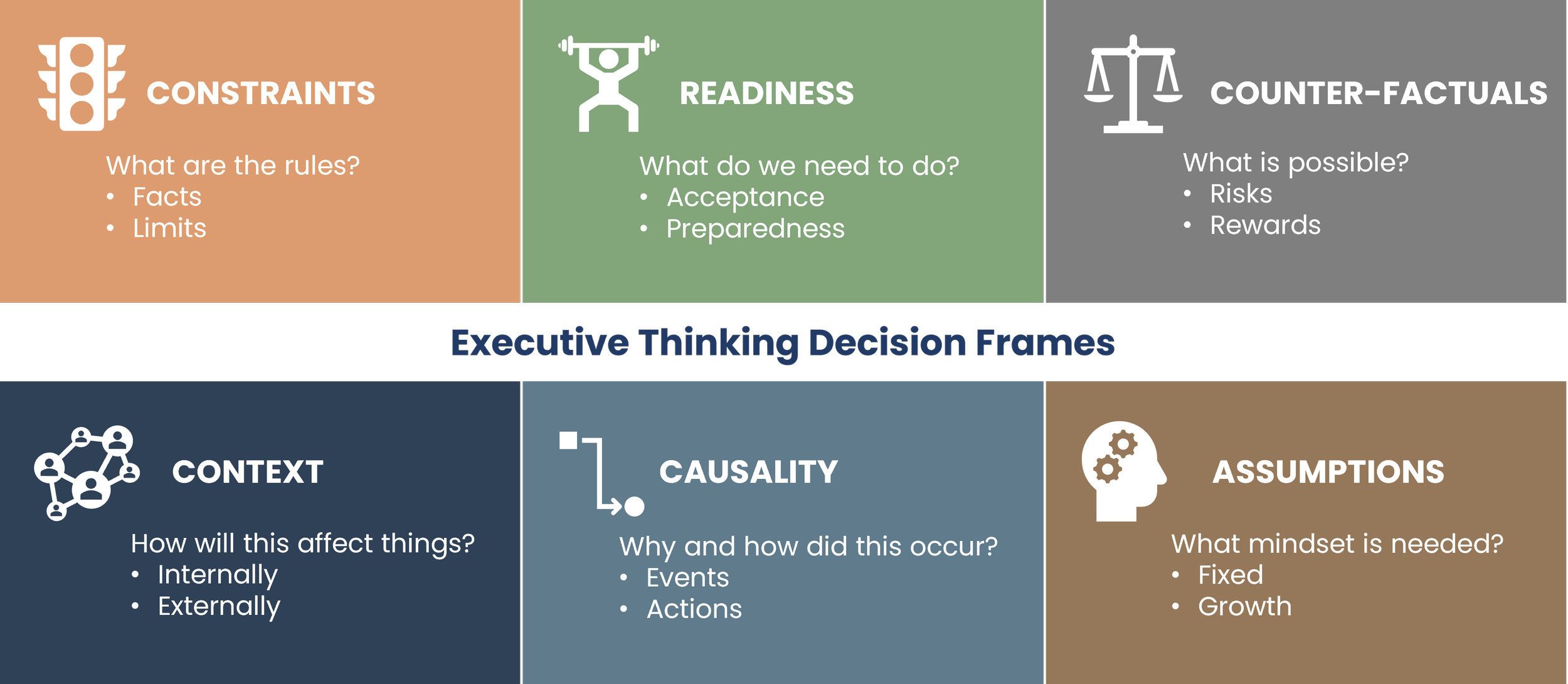
Executive thinking decision frames
In using these frames, it’s important to acknowledge that the best decisions involve multiple subject matter experts. The great news is that everyone in a team can provide a valuable perspective to improve existing activities and inform future ones.
3 things to focus on for better decisions and action
Usefulness – Will this decision lead to action that ethically removes pain or creates a gain for the desired longer-term outcome?
Realism – Is the information used for the decision accurate and reliable?
Discipline – Are the people involved in the decision and resulting action prepared to work with quality and consistency, sustainably, and for scale?
Confident strategic decisions come from operational insights that tell the story behind the data.
To reduce noise and get clarity for action, contact me at +61 407 004 352 or book a conversation and ask about an Adaptive Service Review.
For more articles like this subscribe to my newsletter.
For your outcomes,
Melanie.
Bibliography:
Anggraeni, D. M., Prahani, B., Suprapto, N., Shofiyah, N., & Jatmiko, B. (2023). Systematic review of problem-based learning research in fostering critical thinking skills. Thinking Skills and Creativity, 101334.
Cukier, K., Mayer-Schönberger, V., & de Véricourt, F., (2021). Framers: Human Advantage in an Age of Technology and Turmoil. New York: Dutton.
Essien, A., Bukoye, O. T., O’Dea, X., & Kremantzis, M. (2024). The influence of AI text generators on critical thinking skills in UK business schools. Studies in Higher Education, 1-18.
Krupat, E., Sprague, J. M., Wolpaw, D., Haidet, P., Hatem, D., & O’Brien, B. (2011). Thinking critically about critical thinking: ability, disposition or both? Medical education, 45(6), 625-635.
Wilkinson, D. (2024). The Impact of Generative AI Use on Critical Thinking, Higher Order Thinking Skills (HOTS) and Cognitive Performance, Oxford Review Research Briefing. decision making decision making for action